By the NVN Marine Expert Team — Our team has spent 10+ years on the water installing, testing, and troubleshooting marine electronics from the Gulf Coast to the Great Lakes. We're authorized resellers for every brand we review, and we only recommend gear we'd trust on our own boats.
A guy walked into the picture last spring with a 17-foot aluminum jon boat, a tight budget, and one question: "Can I get a real fish finder and a radio without spending a grand?" Short answer, yes. We built him a package for under $470 that he still runs today, and it out-fishes half the boats at his ramp that cost ten times as much.
Budget marine electronics have gotten genuinely good. Not "good for the price" — good, period. The panel-mount CHIRP sonar that cost $700 five years ago now sells for $330 and reads structure at 40 feet clean enough to count individual fish. Class D VHF radios with a dedicated Channel 70 receiver run $150. You do not need to remortgage the boat to fish safely and find fish.
This is our working list of the best marine electronics under $500 you can buy in 2026, split by what actually matters on the water: sonar, communications, and navigation. Every price here is real, checked this month, and every unit is something we've either installed for a customer or run ourselves. Where a cheaper unit has a real weakness, we'll tell you.
What "budget" actually buys you in 2026
Here's the honest framing. Under $500, you're not getting a 12-inch multifunction display that runs radar, sonar, and autopilot on one glass. That's fine. Most boats under 22 feet don't need one. What you are getting: bright color screens (4 to 7 inches), built-in GPS with basic charts, CHIRP sonar that genuinely works, and radios that meet Coast Guard DSC requirements.
The trade-offs are real and worth knowing. Budget units use smaller processors, so map redraws lag a half-second when you zoom. Screens are dimmer — around 500 to 1,000 nits versus 1,200-plus on premium glass — so they wash out under a hard noon sun. Networking is limited or nonexistent; most of these are standalone units, not nodes on an NMEA 2000 backbone. And you won't get live-scanning sonar at this price. That tech starts around $1,500 all-in and there's no shortcut yet.
None of that matters much on a small boat running inshore or on a lake. It matters a lot if you're 40 miles offshore. Know which boat you're building for.
Best budget fish finders under $500
Sonar is where budget money goes furthest right now. The gap between a $200 unit and a $2,000 unit is real, but the gap between a $200 unit and a $400 unit is bigger than you'd think.
Garmin Striker Vivid 5cv — $329.99
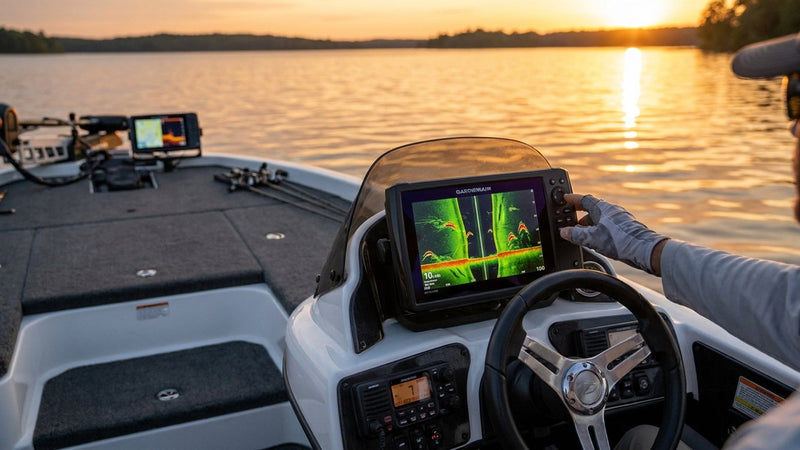
This is the one we recommend most. The Garmin Striker Vivid 5cv is a 5-inch, GPS-enabled fish finder with Garmin's traditional CHIRP sonar plus ClearVü down-scan, and it ships with the GT20-TM transom transducer, so there's nothing else to buy. The seven "vivid" color palettes aren't marketing fluff — swapping to the amber palette genuinely makes bait balls pop against a muddy bottom. We've run this on a bay boat in 3-foot chop and the screen stayed readable.
What it does well: Quickdraw Contours. You drive your lake, and it builds 1-foot contour maps of the bottom as you go. For anglers fishing water that isn't well-charted, this feature alone is worth the price of admission.
Where it's weak: no side imaging. If you fish sprawling flats and want to scan wide, the 5cv can't do it. Step up to the 7-inch Striker Vivid 7sv (which adds SideVü) if that's you, but it pushes past $450.
Humminbird PiranhaMAX 4 DI — $199.99
Two hundred bucks, and it works. The Humminbird PiranhaMAX 4 DI runs a 4.3-inch color screen with dual-beam sonar and Down Imaging, which is genuinely rare at this price. Fish ID+ puts little fish icons on screen for people who don't want to read raw sonar returns, and you can turn it off once you learn to read arches.
This is the unit for a first boat, a kayak, or a backup on a bigger rig. No GPS, no mapping — it's a pure "what's under me" sonar. We put one on a customer's 14-foot skiff last year and he found a submerged roadbed holding crappie he'd been driving over for three seasons.
The honest weakness: the transom transducer reads false bottom above roughly 20 knots. Slow down and it cleans up. It's not a running-sonar unit, and Humminbird never pretended it was.
Lowrance HOOK Reveal 5 SplitShot — $399.99
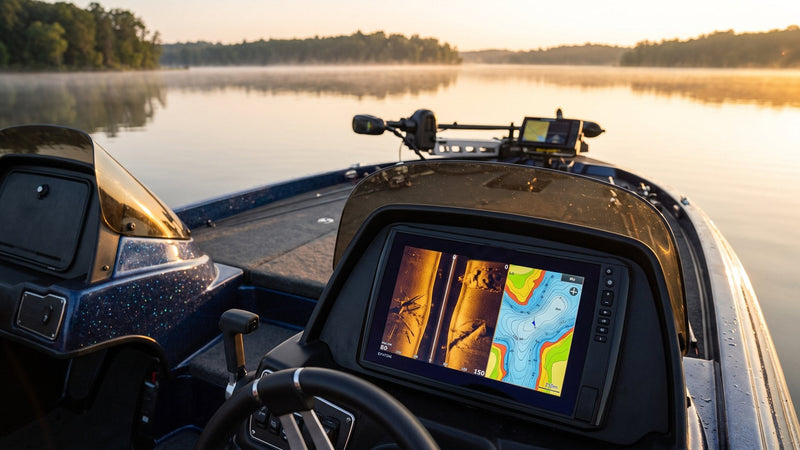
The Lowrance HOOK Reveal 5 splits the difference. Five-inch SolarMAX display (noticeably brighter than the PiranhaMAX), CHIRP sonar plus DownScan Imaging on the SplitShot transducer, and FishReveal, which overlays the two so you see the arch and the structure together. It comes preloaded with C-MAP US Inland charts covering thousands of lakes.
Autotuning sonar is the sleeper feature here. It adjusts sensitivity on the fly as bottom conditions change, so you're not fiddling with gain every time you move from mud to rock. We'd put this a half-step above the Garmin for pure freshwater lake fishing, and a half-step below for coastal work.
Best budget VHF radios under $500
A VHF radio isn't optional gear on a boat that leaves the dock. Cell phones die, lose signal, and can't broadcast a Mayday to every boat in range at once. The good news: you can meet every safety requirement for well under $200. If you want the full rundown, see our best marine VHF radios of 2026 guide.
Standard Horizon GX1400 (fixed mount) — $149.99
For a fixed-mount radio, the Standard Horizon GX1400 is the value pick and has been for years. Full 25-watt Class D DSC with a separate Channel 70 receiver — that separate receiver matters, because it means the radio can catch an incoming distress call even while you're talking on another channel.
Wire the GPS. We can't say this enough — a DSC radio without a position source will broadcast a distress call with no coordinates, which is close to useless. It takes ten minutes to do right.
Standard Horizon HX210 (handheld) — $119.99
Every boat should carry a handheld VHF, even if it has a fixed mount, because when your electrical system dies the handheld still talks. The Standard Horizon HX210 floats, flashes a water-activated strobe when it hits the water, and pushes 6 watts — strong for a compact handheld. As a backup, a kayak radio, or a dinghy radio, it's hard to beat at $120. Three-year warranty, too.
Best budget chartplotter combo under $500
This is the tightest category, because real GPS chartplotting with detailed charts usually pushes past $500. But there's one that sneaks in.
Garmin echoMAP UHD2 55cv — $499.99
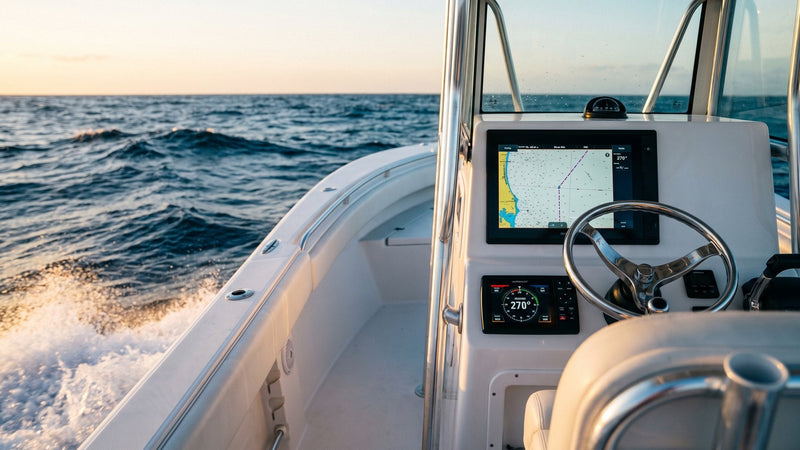
Right at the line. The Garmin echoMAP UHD2 55cv is a true 5.5-inch chartplotter/fish finder combo: CHIRP traditional plus UHD ClearVü sonar, built-in high-detail Garmin Navionics+ coastal charts, and — this is the part budget shoppers miss — it can join an NMEA 2000 network and share sonar with a second display or add a radar or autopilot later. It's the only unit on this list with a real upgrade path.
For a center console under 24 feet doing inshore and near-coastal work, this is the smart buy. If you're weighing screen sizes, our best chartplotters for small boats guide goes deeper. We'll be honest about the ceiling: 5.5 inches is small for coastal navigation, and there's no touchscreen at this price. But it's a genuine chartplotter that grows with the boat.
Budget marine electronics comparison
| Product | Category | Screen | GPS | Sonar | Price |
|---|---|---|---|---|---|
| Garmin Striker Vivid 5cv | Fish finder | 5" | Yes | CHIRP + ClearVü | $329.99 |
| Humminbird PiranhaMAX 4 DI | Fish finder | 4.3" | No | Dual-beam + DI | $199.99 |
| Lowrance HOOK Reveal 5 SplitShot | Fish finder | 5" | Yes | CHIRP + DownScan | $399.99 |
| Standard Horizon GX1400 | VHF (fixed) | — | No | — | $149.99 |
| Standard Horizon HX210 | VHF (handheld) | — | No | — | $119.99 |
| Garmin echoMAP UHD2 55cv | Chartplotter combo | 5.5" | Yes | CHIRP + ClearVü | $499.99 |
How to spend your budget: three questions
Before you buy anything, answer these. They'll save you from overspending and from buying the wrong tool.
What water do you fish, and how far out? Inland lakes and rivers? A fish finder with inland charts (HOOK Reveal, Striker Vivid) is your priority and you may skip the marine chartplotter entirely. Coastal or near-shore saltwater? Flip it — the echoMAP's marine charts and a solid VHF matter more than fancy sonar.
Do you already have a radio? If your boat has zero communications gear, buy the VHF first. A $150 GX1400 does more for your safety than a $400 fish finder does for your catch. Fish are optional. Getting home isn't.
Standalone, or will you add to it later? If this is your only electronics purchase ever, buy the best standalone unit in your priority category. If you're building toward a networked helm, start with the echoMAP UHD2 55cv because it's the only unit here that plays on an NMEA 2000 backbone. The others are islands — great islands, but islands. Picking the right transducer matters too; our transducer guide covers that.
The bottom line
If we had exactly $500 and a 17-to-20-foot boat, here's what we'd do. Coastal boat: Garmin echoMAP UHD2 55cv and a handheld HX210, and add a fixed radio next season. Freshwater boat: Garmin Striker Vivid 5cv, the GX1400 fixed radio, and pocket the change. Tightest possible budget under $350 total: PiranhaMAX 4 DI plus the HX210 handheld, and you're on the water safely and finding fish for the price of one tank of fuel on a big offshore rig.
The best marine electronics under $500 aren't compromises anymore. They're the right tool for the boat most people actually own.
👉 Shop All Marine Electronics at NVN Marine →
Frequently Asked Questions
What is the best budget fish finder under $500?
For most anglers, the Garmin Striker Vivid 5cv at $329.99 is the best value. It combines CHIRP sonar, ClearVü down-imaging, built-in GPS, and Quickdraw Contours mapping, and it includes the transducer. If you fish primarily freshwater lakes, the Lowrance HOOK Reveal 5 SplitShot ($399.99) is an equally strong pick with a brighter display and preloaded inland charts.
Can you get a real chartplotter for under $500?
Yes, but the options are limited. The Garmin echoMAP UHD2 55cv ($499.99) is a genuine 5.5-inch chartplotter/sonar combo with high-detail marine charts and NMEA 2000 networking. Below that price, most "chartplotters" are fish finders with inland lake maps rather than full coastal cartography.
Do I really need a VHF radio if I have a cell phone?
Yes. A VHF radio broadcasts a distress call to every boat and Coast Guard station in range simultaneously, works where cell coverage doesn't, and with DSC can send your exact position at the push of a button. Cell phones do none of that reliably on the water. A fixed-mount VHF like the Standard Horizon GX1400 ($149.99) should be the first electronics purchase on any boat.
What's the difference between CHIRP sonar and regular sonar on budget units?
CHIRP (Compressed High-Intensity Radiated Pulse) sweeps across a range of frequencies instead of pinging a single one, which produces clearer target separation and better detail. Nearly every fish finder on this list uses CHIRP, and it's the main reason budget sonar performs so much better than it did a decade ago.
Will a budget fish finder work at high speed?
Partly. Budget transom-mount transducers, like the one on the Humminbird PiranhaMAX 4 DI, tend to read false bottom or lose the signal above roughly 20 knots because of turbulence and aeration over the transducer face. Slowing down restores a clean reading. If you need reliable high-speed sonar, a properly mounted transducer and a mid-tier unit matter more than the screen.
Should I buy a fish finder or a VHF radio first?
Buy the VHF first if your boat has no communications gear. Safety equipment takes priority over fish-finding equipment. A $150 fixed-mount VHF does more for your wellbeing on the water than any fish finder. Once you have a reliable radio, put the rest of your budget toward sonar or a chartplotter.